
Tutoriels techniques
SME Business Software Comparison: Odoo, Sage, EBP, Dolibarr, Pennylane... Which One to Choose in 2026?
SME business software comparison: a selection method, a summary table of 10 software packages, public prices collected in November 2026 and the state of e-invoicing
By DROUOT Thomas ·
Contents
Updated November 8, 2026.
This SME business software comparison starts from a simple observation: there is no best software in absolute terms, only software that fits your size, your industry and your three-year budget. For a small service business that mainly wants to invoice and track its cash flow, a SaaS tool such as Pennylane, Axonaut or Sellsy is often enough. For an SME with 5 to 50 employees that manages inventory, purchasing, manufacturing or an online store, an integrated ERP such as Odoo, Sage 100, Cegid or Business Central becomes more relevant, and Odoo stands out for its scope and its license price.
This page is the entry point to our series. It offers a selection method, a summary table of the ten software packages French SMEs look at most, and then links to a detailed comparison for each family. Skillreso is an Odoo integrator: we say so up front, and for each competitor we point out the cases where it is a better choice than Odoo.
How to choose business management software for an SME: 7 criteria
Before comparing brands, define your needs using these seven criteria.
1. Company size and number of users
The price of most software depends on the number of users. Count the people who will actually enter data (sales, accounting, logistics, shop floor), not your total headcount.
2. Your industry
A distributor needs purchasing, inventory and customer price lists. A manufacturer needs bills of materials, manufacturing orders and traceability. An online retailer needs reliable synchronization of orders and inventory with its store. A construction company needs detailed quotes, progress billing and job-site tracking. Check that the software covers your industry out of the box, or through a recognized module, before looking at the price.
3. Functional scope
There are two opposing approaches. The first combines specialized tools: accounting software, a CRM, an invoicing tool and payroll software, linked by imports or connectors. The second uses an integrated ERP, where sales, purchasing, inventory and accounting share the same database. The first model gets you started faster; the second avoids double data entry as the company grows.
4. Your budget over 3 years
Compare the total cost over three years, not an introductory monthly price. This cost includes licenses or subscriptions, hosting, implementation (configuration, data migration, training), add-on modules, maintenance and version upgrades. For Odoo, our Odoo implementation price calculator gives you a price range in a few minutes.
5. E-invoicing in 2026-2027
Since September 1, 2026, all VAT-registered businesses in France must be able to receive electronic invoices, and large and mid-sized companies must issue them. SMEs and micro-businesses will have to issue their electronic invoices and transmit their data (e-reporting) from September 1, 2027. Exchanges go through an “approved platform” (formerly called PDP), registered by the DGFiP, the French tax administration. Your software must therefore be an approved platform itself, or be connected to one. We cover this point in detail in our comparison facture électronique : Sage, EBP, Pennylane et Odoo, et dans notre guide e-invoicing with Odoo in 2026-2027.
6. Hosting
There are three models: the vendor's SaaS (nothing to manage, but you follow its update schedule), hosting with a service provider (more control, with data in France if you choose), and installation on your own servers. Some software is SaaS-only (Pennylane, Axonaut, Sellsy). Others give you the choice (Odoo, Dolibarr, Sage 100, SAP Business One). If data location matters to you or your customers, check it from the start.
7. Scalability
Ask yourself where your company will be in five years: a second company, a subsidiary in Belgium or Switzerland, an online store, a production workshop. Software that covers your current needs well but cannot handle multiple companies, multiple currencies or manufacturing will force you to change tools at the worst possible time. A documented API and a partner ecosystem also reduce your dependence on a single provider.
SME business software comparison table for 2026
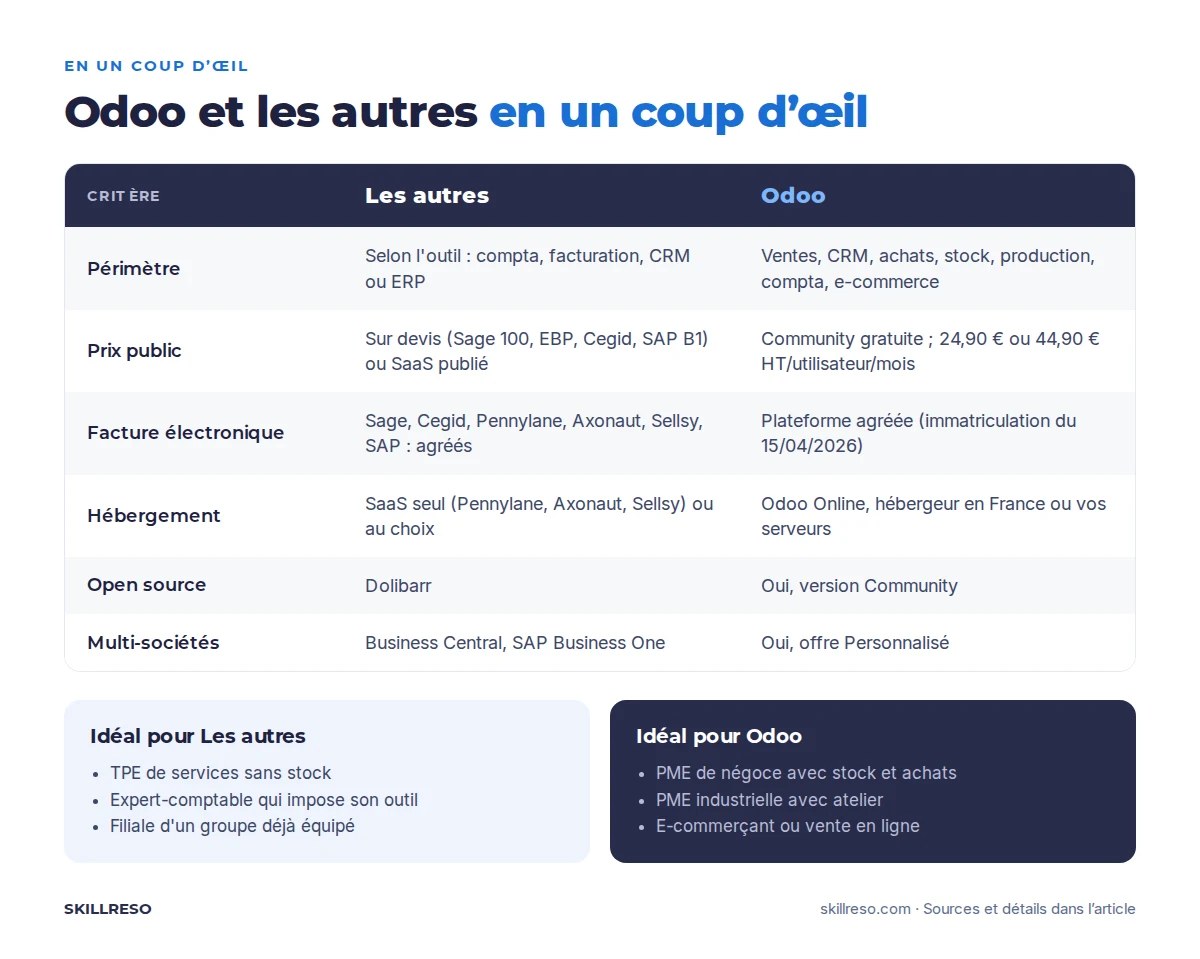
The prices below are public entry-level prices, collected in November 2026 from the vendors' websites, excluding taxes. They do not cover implementation. When a vendor does not publish its pricing, we say so rather than putting forward a figure. The “approved platform” status is checked against the official list published by the DGFiP on impots.gouv.fr (version amended on November 3, 2026).
| Software | Positioning | Target | Scope | Public entry price (excl. VAT, Nov. 2026) | E-invoicing |
|---|---|---|---|---|---|
| Odoo (Odoo SA, Belgium) | Modular ERP, open source (Community) and Enterprise | Very small businesses, SMEs, mid-sized companies | Sales, CRM, purchasing, inventory, manufacturing, accounting, e-commerce, projects, HR, etc. | Community free; Enterprise Standard €24.90 and Custom €44.90 per user per month (billed annually), often discounted in the first year | Odoo is an approved platform (final registration on 04/15/2026) |
| Sage 100 (Sage) | Long-established management suite for SMEs | SMEs, mid-sized companies | Accounting, sales management, fixed assets, cash management, payroll depending on modules | No complete public pricing found: quote-based, often through a reseller | Sage is an approved platform (final registration on 12/22/2025) |
| EBP (part of the Cegid group since 2024) | Accounting and management software for small businesses | Very small businesses, small SMEs | Accounting, sales management, payroll, industry editions (including construction) | ACTIV ranges listed as “quote-based” (1 user and 1 company included) | Built-in approved platform according to the product sheets (Shine for ACTIV sales management) |
| Dolibarr (Dolibarr association) | Open source ERP and CRM | Freelancers, nonprofits, very small businesses | Contacts, quotes, invoices, inventory, CRM, point of sale, Dolistore modules | Free software; DoliCloud hosting from €14 per user per month | Dedicated module and connection to a partner approved platform (EsaLink, SuperPDP according to dolibarr.org) |
| Pennylane | Online accounting and financial management, connected with your accountant | Freelancers, very small businesses, accounting firms | Invoicing, bookkeeping, accounting, cash management, supplier payments | Freelancer plans from €7 to €79 per month (1 user); small business and SME plans quote-based | Pennylane is an approved platform (final registration on 12/11/2025) |
| Axonaut | All-in-one SaaS management software | Very small service and trading businesses | CRM, quotes, invoicing, accounting, cash management, inventory, projects | €97 per user per month with no commitment, from €58.20 with a 3-year commitment | Axonaut is an approved platform (final registration on 01/08/2026) |
| Sellsy (TeamSystem group) | SaaS CRM and invoicing | Sales-driven very small businesses and SMEs | CRM, quotes, invoicing, cash management, marketing | Invoicing only from €39 per user per month (billed annually, before discounts); Sales and Invoicing €49, 2 users minimum | TeamSystem Sellsy is an approved platform (final registration on 12/24/2025) |
| Cegid (Cegid XRP Flex) | Cloud ERP from a major French vendor | SMEs, mid-sized companies | Finance, purchasing, sales, inventory, manufacturing, depending on the plan | Quote-based, no public pricing | Cegid is an approved platform (final registration on 12/18/2025) |
| Microsoft Dynamics 365 Business Central | Microsoft's ERP, integrated with Microsoft 365 | SMEs, subsidiaries of groups | Finance, sales, purchasing, inventory, projects; manufacturing in Premium | Essentials €69.30, Premium €95.30, Team Members €6.90 per user per month (billed annually) | Microsoft is not an approved platform: connection to an approved platform through connectors |
| SAP Business One | SAP's ERP for SMEs | SMEs, subsidiaries of groups | Finance, sales, purchasing, inventory, manufacturing, CRM | Quote-based, sold only through partners | SAP SE is an approved platform (registration on 01/15/2026); how Business One connects should be checked with the partner |
Long-established accounting and management software: Sage 100 and EBP
Sage and EBP have equipped a large share of French very small businesses and SMEs for several decades. Their strengths are well known: solid French accounting, accountants who know the tools well, a dense reseller network and industry-specific editions. EBP joined the Cegid group in July 2024 and continues to sell its product ranges under its own brand.
Their limitation lies in their architecture: accounting, sales management, payroll and sometimes inventory are separate modules, often purchased and configured separately. CRM, e-commerce or manufacturing frequently rely on third-party software. For a company that wants a single tool, from prospecting to accounting, this is where Odoo adds the most value.
Code source : propriétaire ou ouvert. Sage 100 et EBP sont des logiciels propriétaires : leur code source n'est pas accessible. On les personnalise par les outils que l'éditeur prévoit (champs personnalisés, états, API et SDK, selon l'offre et le contrat), pas en modifiant le logiciel lui-même. Odoo Community est sous licence open source (LGPL v3) : son code se lit, se modifie et s'enrichit de modules sur mesure. Odoo Enterprise, la version payante, est livrée avec son code source consultable, sous licence commerciale. Un code ouvert n'est pas un meilleur choix en soi : il réduit la dépendance à un éditeur, mais demande un intégrateur compétent.
When to keep Sage or EBP rather than switch to Odoo
- Your needs are limited to accounting, invoicing and payroll, with no complex inventory or CRM.
- Your accountant works directly in your Sage or EBP database and you do not want to change that arrangement.
- Your current software is up to date, compliant with e-invoicing, and your teams are happy with it: changing tools has a real human cost.
To learn more: our Sage 100 vs Odoo comparison et notre comparatif EBP et Odoo, avec un scénario de coût sur trois ans et une méthode de migration.
Un projet sur Sage 100 ? Skillreso est intégrateur Odoo, pas Sage. Si Sage 100 est le bon choix pour votre entreprise, nous pouvons vous mettre en relation avec un partenaire que nous connaissons, qui travaille sur cet outil. Par transparence : nous avons avec ce partenaire un accord de recommandation réciproque, avec un intéressement financier de part et d'autre.
Open source software: Odoo and Dolibarr
Odoo and Dolibarr have one thing in common: their source code is open, which limits dependence on a single vendor. Their models differ. Dolibarr is backed by an association and a community of developers and integrators; the software is free, extended by modules sold on the Dolistore, and it can be installed on your own server or hosted by a provider such as DoliCloud. Odoo is developed by the company Odoo SA, which publishes a free Community edition and a paid, more complete Enterprise edition (full accounting, Studio, mobile app, vendor support). Odoo version 20 was released in September 2026.
Dolibarr appeals to freelancers, nonprofits and small organizations that want a simple, low-cost tool. Odoo covers a broader scope and goes further in manufacturing, logistics, e-commerce and multi-company management, which makes it better suited to growing SMEs. On the other hand, an Odoo project requires more configuration and more structured support.
When to choose Dolibarr rather than Odoo
- You are a very small organization with a minimal software budget and simple needs (quotes, invoices, contact management).
- You want a fully open source tool, with no paid edition, and you have the technical skills to host it.
- Your operations fit within the standard modules and do not require deep integration between inventory, manufacturing and accounting.
Le détail est dans notre comparatif Dolibarr et Odoo.
SaaS tools for very small businesses: Pennylane, Axonaut and Sellsy
These three French vendors offer online software that is quick to get started with and designed for small businesses. Their strengths differ.
- Pennylane starts from accounting and the relationship with your accountant: bank synchronization, bookkeeping, invoices, supplier payments. Many accounting firms have adopted it.
- Axonaut aims to be an all-in-one tool for very small businesses: CRM, quotes, invoicing, accounting, cash management and inventory in a single plan, with every feature included.
- Sellsy, a subsidiary of the Italian group TeamSystem, is first and foremost a sales CRM, complemented by invoicing and cash management.
All three are registered as approved platforms, which simplifies the e-invoicing reform for their customers. Their limits show when a company needs advanced logistics (multiple warehouses, replenishment), manufacturing, multi-company management or specific business rules. Moving to an ERP then becomes a topic.
When to choose Pennylane, Axonaut or Sellsy rather than Odoo
- You are a very small service business with no significant inventory, and you want to get started in a few days without an implementation project.
- Your priority is the relationship with your accountant (Pennylane) or sales management (Sellsy).
- You have few users and do not foresee any need for manufacturing, e-commerce or multi-company management in the medium term.
Nous les comparons en détail dans Pennylane, Axonaut, Sellsy ou Odoo : que choisir pour une TPE.
ERPs from major vendors: Cegid, Business Central and SAP Business One
Cegid, Microsoft and SAP offer proven ERPs, backed by solid groups and networks of certified partners. Cegid XRP Flex is a French cloud ERP for SMEs and mid-sized companies, sold on a quote basis. Microsoft Dynamics 365 Business Central integrates naturally with Microsoft 365 (Outlook, Excel, Teams) and publishes its prices: €69.30 excl. VAT per user per month for Essentials, €95.30 for Premium. SAP Business One is SAP's ERP for SMEs, often chosen by subsidiaries of groups already running SAP; it is sold only through partners.
These solutions are well suited to companies with group-level requirements (consolidation, reporting imposed by the parent company, internal control). Their entry cost is generally higher, both in licenses and in implementation, and their standard scope is often more focused on finance and logistics than on CRM, website or e-commerce, which Odoo includes natively.
When to choose Cegid, Business Central or SAP Business One rather than Odoo
- Your parent company requires an ERP or a reporting format compatible with its own system.
- Your IT systems already rely heavily on Microsoft 365 and you want an ERP in the same ecosystem (Business Central).
- You need a local integrator for a major vendor, with references in your specific industry, and you have the matching budget.
Pour le détail : notre comparatif Cegid et Odoo et Business Central, SAP Business One ou Odoo.
Which ERP for an SME: which profile, which software?
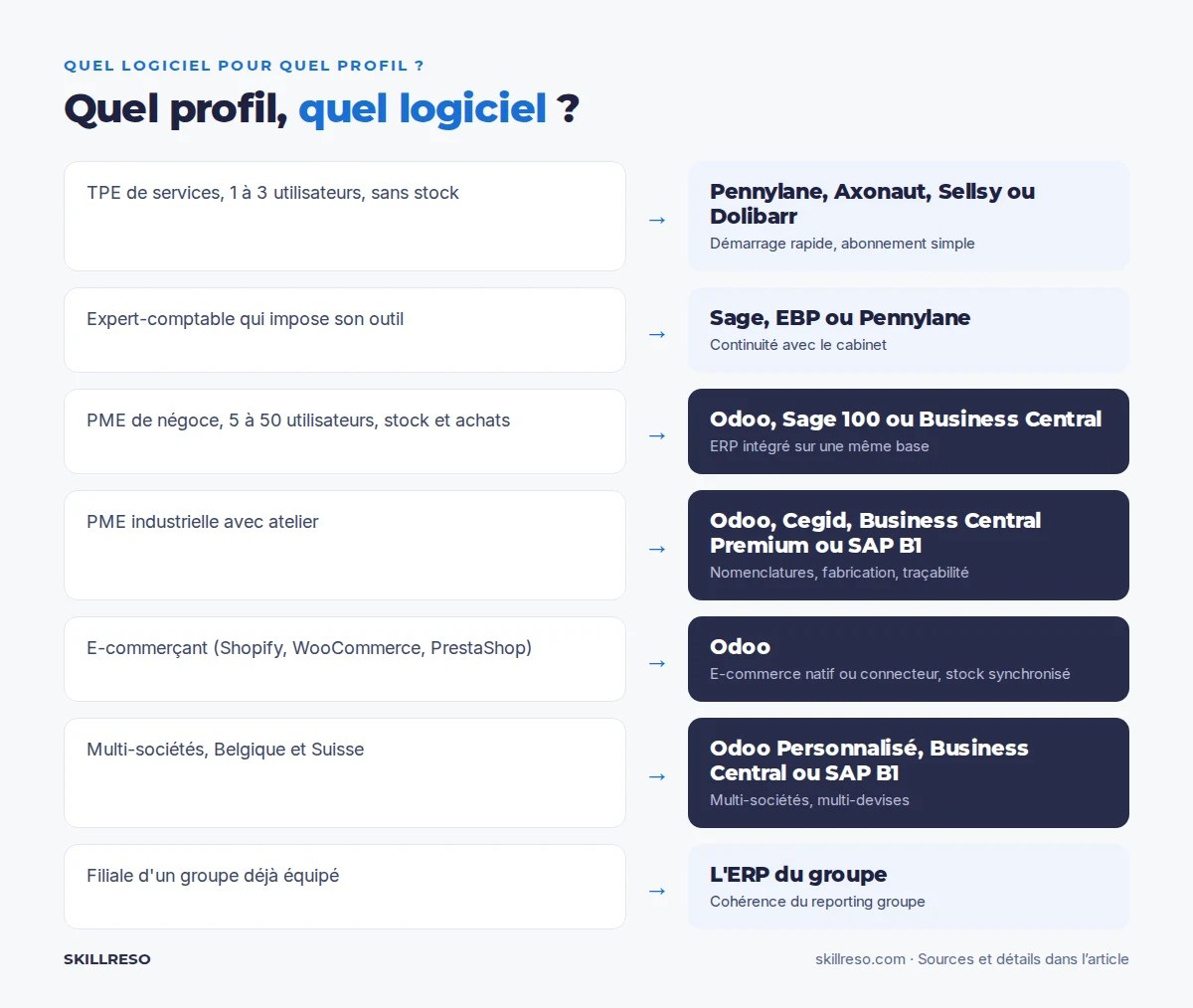
This grid is only a guide: two companies of the same size can have very different needs.
| Your profile | Software to look at first | Why |
|---|---|---|
| Freelancer or small service business, 1 to 3 users, no inventory | Pennylane, Axonaut, Sellsy, Dolibarr | Quick start, simple subscription, e-invoicing included |
| Small business or SME whose accountant requires their own tool | Sage, EBP, Pennylane | Continuity with the accounting firm; Odoo remains an option with an FEC export or accountant access |
| Distribution SME, 5 to 50 users, inventory and purchasing | Odoo, Sage 100, Business Central | Need for an integrated ERP: purchasing, inventory, sales and accounting on the same database |
| Manufacturing SME with a workshop | Odoo, Cegid, Business Central Premium, SAP Business One | Bills of materials, manufacturing orders, traceability; see our page manufacturing and production with Odoo |
| Online retailer (Shopify, WooCommerce, PrestaShop) or online sales | Odoo | Native online store or reliable Odoo and Shopify connection, synchronized inventory |
| Construction company | EBP and Sage (construction editions), Odoo | Long-established industry editions handle quotes and progress billing well; Odoo is a good fit if you want to integrate inventory, purchasing and projects |
| Multi-company group or presence in Belgium and Switzerland | Odoo (Custom plan), Business Central, SAP Business One | Multi-company, multi-currency, tax localizations for several countries |
| Subsidiary of a group that already has a system | The group's ERP (SAP, Microsoft, Cegid) | Consistent reporting and group processes |
Odoo or Sage, EBP, Pennylane: what business management software really costs over 3 years
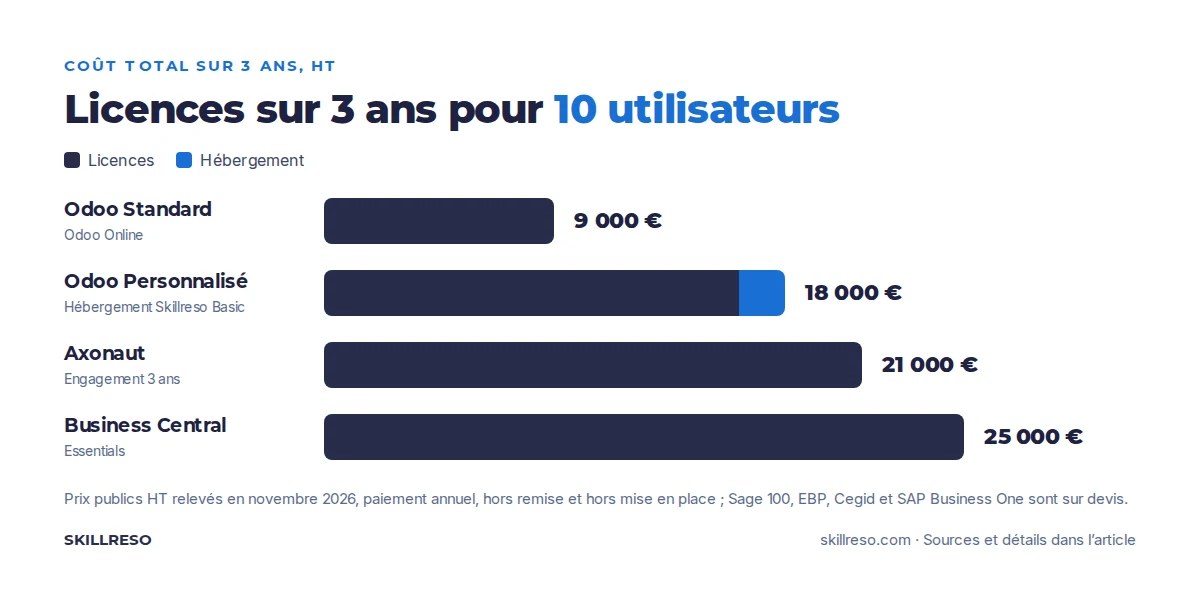
To give an order of magnitude, take an SME with 10 users that wants to manage sales, purchasing, inventory and accounting. Assumptions: public prices excluding VAT collected in November 2026, annual billing, excluding first-year discounts, excluding VAT. Only licenses are included in the calculation below; implementation comes on top in every case.
- Odoo Enterprise Standard (Odoo Online, no custom modules): €24.90 × 10 users × 36 months, or about €9,000 over three years.
- Odoo Enterprise Custom (hosting of your choice, custom modules, multi-company): €44.90 × 10 × 36, or about €16,200, plus hosting if you do not choose Odoo Online (with Skillreso, from €49 excl. VAT per month, or about €1,800 over three years).
- Business Central Essentials: €69.30 × 10 × 36, or about €25,000.
- Axonaut: €58.20 × 10 × 36 with a 3-year commitment, or about €21,000 (at the public per-user price; Axonaut mentions SME pricing depending on team size).
- Sage 100, EBP, Cegid, SAP Business One: no complete public pricing, so no honest calculation is possible without a quote.
Implementation often weighs as much as the licenses. At Skillreso, a day is billed at €780 excl. VAT. A mini Odoo project costs €3,000 to €4,500 excl. VAT, a small project €5,000 to €12,500, a medium project €13,000 to €31,000, and a large project from €31,500 excl. VAT. Training can be partly funded by your OPCO (French training fund): see our OPCO-fundable Odoo training courses. Each detailed comparison includes a complete costed scenario.
E-invoicing: where does this software stand in November 2026?
Receiving electronic invoices has been mandatory for all businesses since September 1, 2026. Issuing them will become mandatory for SMEs and micro-businesses on September 1, 2027, as will e-reporting. By then, every business must have chosen its approved platform.
On the official list updated on November 3, 2026, Odoo, Sage, Cegid, Pennylane, Axonaut, Sellsy (TeamSystem Sellsy) and SAP are among the platforms with final registration. EBP relies on an approved platform built into its offerings. Microsoft does not present itself as an approved platform and connects Business Central to partner platforms. Dolibarr goes through a module and partner platforms. What matters most is that the complete chain (issuing, receiving, statuses, e-reporting) works day to day in your software.
If you already use Odoo, read do you need to upgrade your Odoo version for e-invoicing and our page e-invoicing with Odoo.
SME business software comparison: frequently asked questions
What is the best business management software for an SME in 2026?
There is no universal best software. For a small service business with no inventory, a SaaS tool such as Pennylane, Axonaut or Sellsy is often enough. For an SME that manages inventory, purchasing, manufacturing or e-commerce, an integrated ERP such as Odoo, Sage 100, Cegid or Business Central is a better fit. The right choice depends on your industry, the number of users and the total cost over three years.
Odoo or Sage: which one should you choose?
Sage 100 is a solid choice if your needs center on accounting and sales management, with an accountant who is used to the tool. Odoo is more relevant if you want to bring CRM, sales, purchasing, inventory, manufacturing, website and accounting together in a single piece of software. Odoo publishes its prices (€24.90 or €44.90 excl. VAT per user per month for Enterprise), whereas Sage 100 is sold on a quote basis.
What is the alternative to Sage and EBP for a growing SME?
The alternatives most often considered are Odoo, Cegid, Microsoft Dynamics 365 Business Central and SAP Business One. Odoo stands out for its very broad scope and a public license price lower than that of the major vendors' ERPs. Cegid, Business Central and SAP Business One are well suited to companies with group-level requirements.
Is open source software suitable for an SME?
Yes, provided you choose actively maintained software and a reliable provider. Odoo Community and Dolibarr are free and used by many SMEs. Open source reduces dependence on a vendor, but the real cost lies in configuration, hosting and maintenance.
Does my business software need to be an approved platform for e-invoicing?
No, but it must be connected to an approved platform. From September 1, 2027, an SME will have to issue its electronic invoices through an approved platform of its choice. If your software is itself an approved platform, like Odoo, Sage or Pennylane, the chain is simpler. Otherwise, it needs a reliable connector to an approved platform.
How much does it cost to implement an ERP for an SME?
For Odoo with Skillreso, expect €3,000 to €4,500 excl. VAT for a mini project, €5,000 to €12,500 for a small project and €13,000 to €31,000 for a medium project, excluding licenses. Major vendors' ERPs are generally sold on a quote basis. Always compare the total cost over three years: licenses, hosting, implementation, training and maintenance.
How to move forward with your choice
- List your key processes (sales, purchasing, inventory, manufacturing, accounting) and your actual number of users.
- Shortlist two or three software packages using the table and grid above, then read the corresponding detailed comparisons.
- Estimate your Odoo budget with our Odoo implementation price calculator.
- See Odoo applied to your own use cases during an Odoo demo.
- Book a free assessment of your needs : we will tell you frankly whether Odoo is a good fit or not.
To understand how a project unfolds, see our Odoo implementation method and ourOdoo Enterprise and Community hosting options in France.