
Tutoriels techniques
EBP vs Odoo: Which Management Software for Your Small Business in 2026?
Features, 3-year pricing, e-invoicing and migration: an honest comparison, including the cases where EBP is enough.
By DROUOT Thomas ·
Contents
Updated November 8, 2026.
EBP vs Odoo: for a small business that needs reliable accounting and invoicing with one or two users, EBP is very often enough and costs less to get started. Odoo becomes more relevant when the business wants to bring sales, purchasing, inventory, CRM, the e-commerce site or manufacturing together in a single tool, with several users. The right choice therefore depends less on the software than on your scope and your growth trajectory.
EBP and Odoo at a glance
EBP is a French software publisher founded more than 40 years ago, specializing in management software for small businesses and SMEs: accounting, sales management, payroll, construction, point of sale. Since July 2024, EBP has belonged to the Cegid group and presents itself as "EBP, A Cegid Company" (and not to the Sage group, contrary to a fairly common belief). As of November 2026, the main range comes in three tiers, ACTIV, PRO and ELITE, for both EBP Comptabilité and EBP Gestion Commerciale. Each tier is available as an online subscription (SaaS) or as an on-premise subscription, installed on your computer or your server. EBP claims 175,000 subscribing businesses, 7,000 accountants using its software and more than 5,000 IT partners.
Odoo is a Belgian software publisher offering a modular ERP: accounting, invoicing, sales, purchasing, inventory, CRM, website and e-commerce, manufacturing, projects, human resources. It comes in two editions: Community, free and open source, and Enterprise, a per-user subscription. Odoo can be hosted on Odoo Online, on Odoo.sh or on the server of your choice. The logic differs from EBP's: a single database for every function, instead of separate programs connected by exports. To see how Odoo compares with other solutions on the market, read our comparison of management software versus Odoo.
EBP vs Odoo comparison table
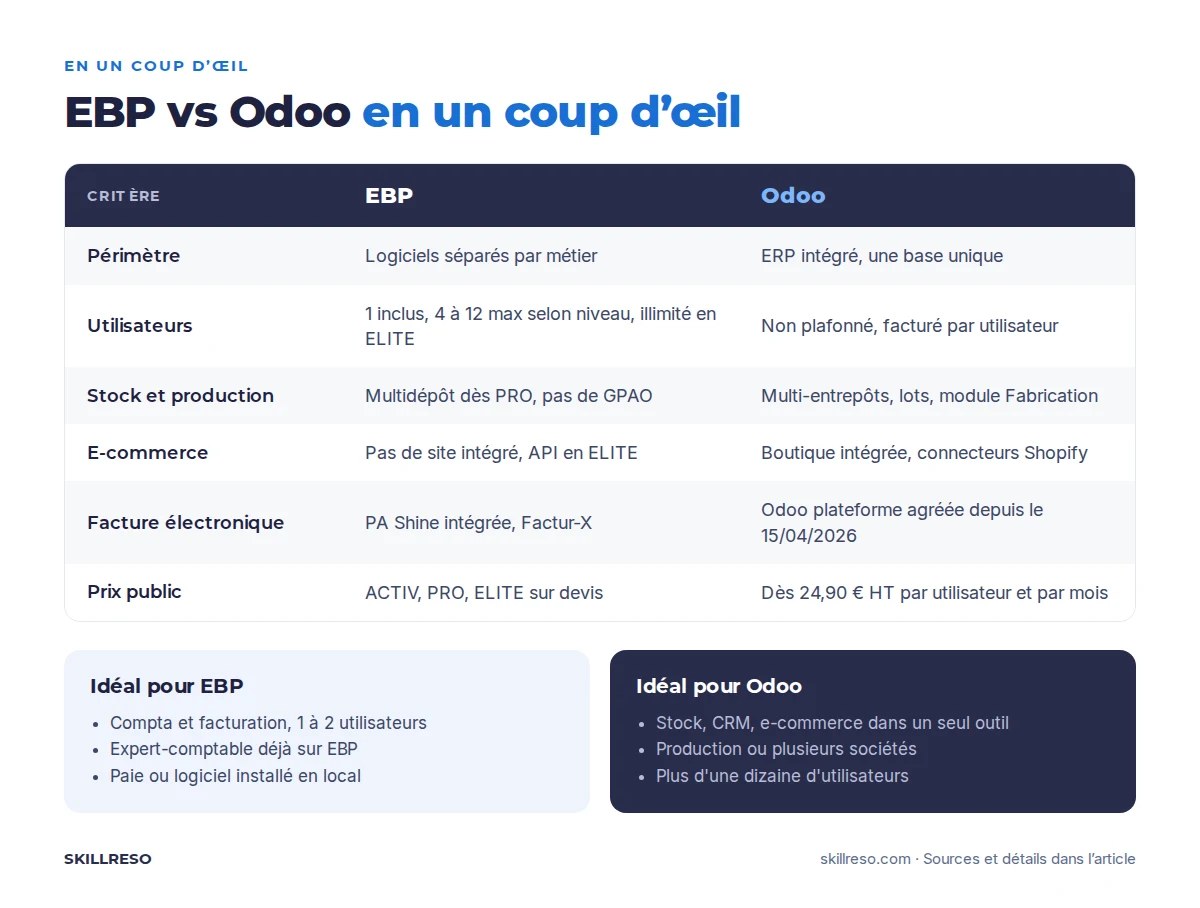
| Criterion | EBP (ACTIV, PRO, ELITE range) | Odoo (Community and Enterprise) |
|---|---|---|
| Functional scope | Separate programs per function: Accounting, Sales Management, Payroll, Construction, Point of Sale | Integrated ERP: a single database for all applications |
| French accounting | Historical strength, very familiar to accountants; analytic accounting up to 3 axes in PRO, unlimited in ELITE | Full accounting with the French chart of accounts, FEC, bank reconciliation, analytic accounting |
| Sales management | Quotes, orders, deliveries, invoices, payment reminders; recurring invoicing from PRO | Quotes, orders, subscriptions, customer portal, online signature, linked to inventory and accounting in real time |
| Inventory | Stock movements, physical counts; multi-warehouse and transfers from PRO | Multi-warehouse, locations, lots and serial numbers, replenishment, barcodes |
| Manufacturing | Sales bills of materials from PRO, no manufacturing module (MRP) | Manufacturing module: bills of materials, manufacturing orders, work centers, subcontracting |
| CRM | Sales rep tracking and statistics within sales management | CRM app with opportunity pipeline, activities, emails |
| E-commerce | No built-in website; connections via API (ELITE) or partners | Built-in website and online store, connectors to Shopify, WooCommerce or PrestaShop |
| Multi-company | Depending on the tier: 1 to 5 companies included in SaaS, 5 to 10 on-premise | Multi-company in a single database (Custom plan in Enterprise) |
| Users | 1 user included; maximum 4 (ACTIV SaaS), 12 (PRO), unlimited (ELITE) | No cap on the number of users, billed per user |
| Hosting | Online with EBP or installed on-premise | Odoo Online, Odoo.sh, integrator's server or in-house server |
| Openness and API | API connection announced for the ELITE tier | Open API, accessible source code (Community), custom modules |
| E-invoicing | Approved platform Shine built into EBP software; Factur-X format | Odoo is itself an approved platform, registered on April 15, 2026 |
| Payroll | Dedicated EBP Paie software | No complete French payroll out of the box: it is usually connected to external payroll software |
| License model and list price | Subscription per program and per tier; ACTIV, PRO, ELITE prices shown as "on quote" on ebp.com in November 2026 | Community free; Enterprise at €24.90 or €44.90 excl. VAT per user per month (billed annually) |
| Ecosystem | Very dense network of resellers and accountants in France | Worldwide network of integration partners, thousands of community modules (OCA) |
EBP vs Odoo: how much does each solution cost over 3 years?
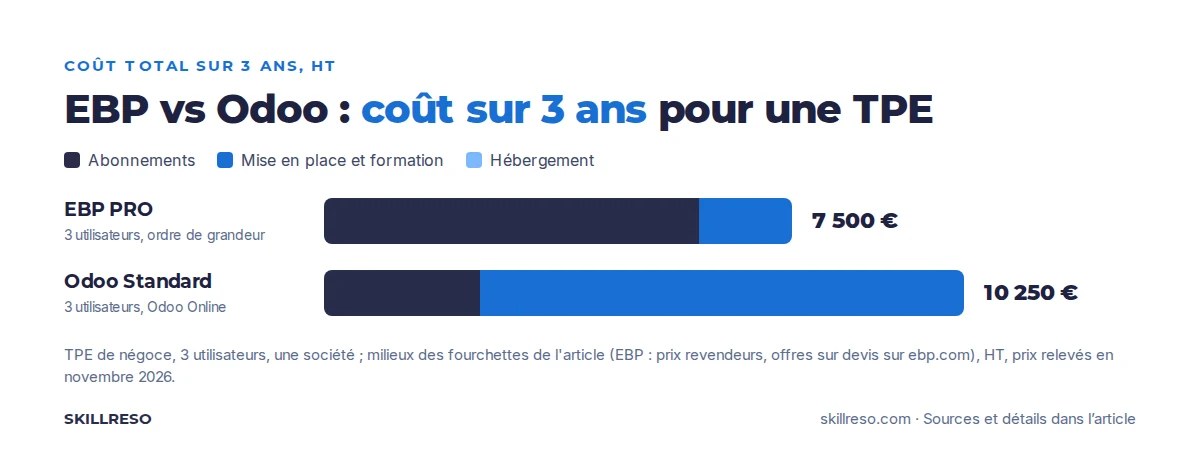
Comparing EBP and Odoo prices calls for caution. As of November 2026, EBP no longer displays public prices for its ACTIV, PRO and ELITE plans on ebp.com: they are listed as "on quote." The EBP amounts below are therefore ballpark figures gathered from resellers and comparison sites in 2026, to be confirmed with a quote.
Scenario assumptions
- A small trading business, 3 users, a single company.
- Needs: accounting, quotes and invoices, purchasing, inventory in one warehouse, e-invoicing.
- EBP side: EBP Comptabilité PRO and EBP Gestion Commerciale PRO on subscription, 2 additional users, light setup by a reseller.
- Odoo side: Enterprise Standard on Odoo Online, 3 users, a mini project or small integration project with Skillreso.
- Prices excl. VAT, as of November 2026. Payroll excluded on both sides.
| Item (3 years, excl. VAT) | EBP PRO (ballpark) | Odoo Enterprise Standard |
|---|---|---|
| Software subscriptions | Around €4,500 to €7,500 (estimate, to be confirmed with a reseller quote) | Around €2,500 (€19.90 the first year with the discount, then €24.90 per user per month) |
| Setup and training | A few reseller days (price on quote) | €3,000 to €12,500 (mini or small project, €780 per day) |
| Hosting | Included in SaaS | Included on Odoo Online |
| Indicative total | Around €5,000 to €10,000 | Around €5,500 to €15,000 |
Taking the middle of the range, EBP comes to roughly €6,000 in subscriptions and roughly €1,500 for setup by a reseller (estimate), or about €7,500 over 3 years. For Odoo, roughly €2,500 in licenses and roughly €7,750 in integration, or about €10,250.
For this small business, EBP is therefore often on par with Odoo, or even cheaper, especially if needs stay stable. The gap reverses as the scope grows: beyond 5 to 10 users, with a CRM, an online store, manufacturing or several companies, EBP requires moving to ELITE (on quote) and adding programs or connectors, whereas Odoo stays on a per-user price with all applications included. If you need custom modules, the API or multi-company, plan on the Custom plan at €44.90 excl. VAT per user per month, plus hosting (Odoo.sh or a Skillreso server in France from €49 excl. VAT per month).
To price your own case on the Odoo side, use our Odoo integration price simulator.
When to choose EBP over Odoo
EBP is a very good choice in many situations. We say so plainly, because an oversized ERP costs time and money.
- Your needs are limited to accounting and invoicing. A tradesperson, a service firm or a small trading business with few product references will find everything it needs in EBP, without an integration project.
- You have one or two users. The ACTIV or PRO tier easily covers this case, and it is quick to learn.
- Your accountant already works with EBP. Exchanges are simple, and many accounting firms know the tool well.
- You want payroll in the same ecosystem. EBP publishes French payroll software, which Odoo does not fully provide out of the box.
- You prefer on-premise software. The on-premise subscription keeps your data on your computer or your server.
- You work in a trade covered by a dedicated version, such as construction (EBP Bâtiment) or retail with a till (EBP Point de Vente).
If your business is not expected to change shape within three years, staying with EBP is often the most rational decision.
When Odoo is the better choice
- You re-enter information across several tools. An order entered in the online store, copied into sales management, then exported to accounting: Odoo eliminates this double entry because everything lives in the same database.
- You sell online. Odoo's e-commerce site shares the catalog, inventory and customers with the rest of the ERP. If you stay on Shopify, a reliable Odoo Shopify connection syncs orders and inventory.
- You manufacture. The Manufacturing module handles bills of materials, manufacturing orders and cost prices. See our page Odoo for production and manufacturing.
- You have more than about ten users, or you manage several companies or several warehouses.
- You have specific processes. Odoo supports custom modules and an open API, without changing software.
- You want to avoid vendor lock-in. The Community edition's code is open, and you choose your host and your integrator.
E-invoicing: EBP and Odoo facing the reform
Since September 1, 2026, all businesses in France must be able to receive electronic invoices, and large and mid-sized companies must issue them. SMEs and micro-businesses will have to issue electronic invoices from September 1, 2027. These exchanges go through an approved platform (formerly called PDP), registered by the tax authorities.
Both solutions have an answer. EBP integrates the approved platform Shine into its software; Shine has been on the official list of approved platforms since May 21, 2026. Odoo is itself an approved platform, registered on April 15, 2026. The reform alone is therefore not a reason to leave EBP. For details on how it works on the Odoo side, read our article E-invoicing with Odoo: what changes in 2026-2027 and our page Odoo e-invoicing.
EBP to Odoo migration: how the switch works
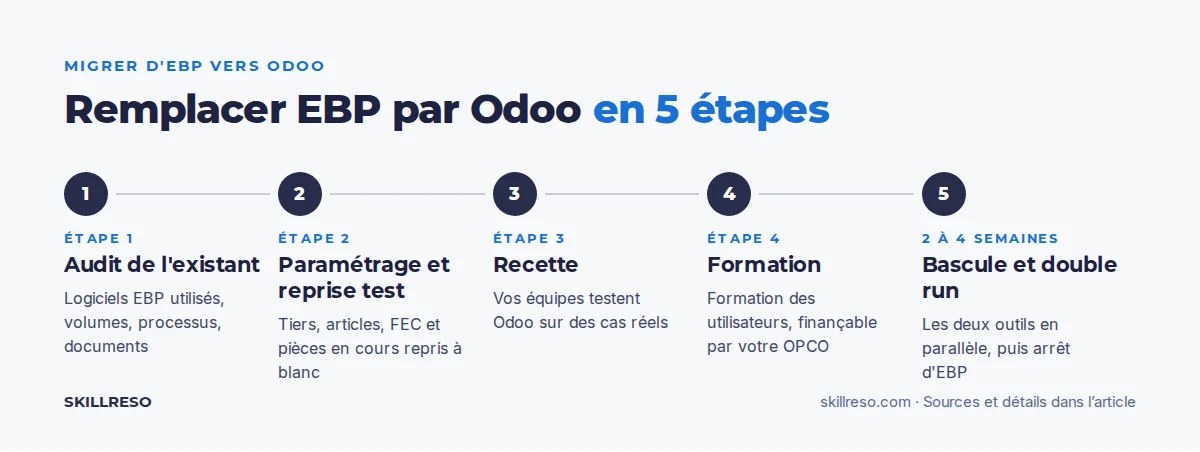
Replacing EBP with Odoo is a well-controlled project when the data is clean and the scope is defined. In our migration projects, data migration and training weigh more than configuration.
Data migrated
- Contacts: customers, suppliers, contact persons, payment terms, exported from EBP as an Excel or CSV file.
- Products: references, product families, sales and purchase prices, barcodes, opening stock at the go-live date.
- Accounting: chart of accounts, opening balances and, if needed, entries for the current fiscal year. The FEC (French standard accounting entries file) exported from EBP provides a reliable basis.
- Open documents: open quotes, undelivered orders, unpaid invoices.
- History: old invoices generally remain viewable in EBP or in a PDF archive, rather than all being migrated.
The steps
- Audit of the existing setup: EBP programs in use, volumes, processes, printed documents.
- Odoo configuration and migration of a first test data set.
- Acceptance testing by your teams on real cases.
- User training, which can be funded by your OPCO (French training fund) through our Odoo training.
- Go-live, preferably at the start of a fiscal year or a month.
Indicative timeline and pitfalls
For a small business moving from EBP Comptabilité and Gestion Commerciale to Odoo, expect anywhere from a few weeks to two or three months, depending on data volume and your teams' availability. The most common pitfalls: duplicate product records, customer accounts linked incorrectly, invoice numbering that must remain continuous, and payroll forgotten in the scope. Also plan a short parallel-run period, two to four weeks, during which you compare the results of both tools before switching off EBP. Our Odoo implementation methodology details each phase.
EBP vs Odoo: frequently asked questions
EBP or Odoo: which one should a small business choose?
For a small business with 1 to 3 users whose needs are limited to accounting and invoicing, EBP is often enough and can be set up without an integration project. Odoo becomes preferable when the business also wants to manage its inventory, CRM, online store or manufacturing in a single tool. The question to ask is about your scope three years from now, not just today.
Is EBP owned by Sage?
No. EBP has belonged to the Cegid group since July 2024 and presents itself as "EBP, A Cegid Company." Sage is a competing publisher, separate from Cegid.
Can you replace EBP with Odoo mid-year?
Yes, it is possible, but switching at the start of a fiscal year simplifies the accounting. Mid-year, the balances and, if needed, the entries since the start of the fiscal year are migrated from EBP's FEC. Invoices already issued in EBP are kept in the old software or in an archive.
Can my accountant work with Odoo?
Yes. Odoo produces the FEC and French financial statements, and your accountant can be given access to your database. Some firms that are very attached to EBP prefer to receive an export: this is a point to confirm with them before the project.
Should you leave EBP because of e-invoicing?
No. EBP integrates the approved platform Shine, and Odoo is itself an approved platform. The reform is an opportunity to review your tools, but it does not require you to change software.
How much does an EBP to Odoo migration cost?
At Skillreso, a mini project costs €3,000 to €4,500 excl. VAT and a small project €5,000 to €12,500 excl. VAT, at €780 excl. VAT per day. On top of that come Odoo Enterprise licenses, from €24.90 excl. VAT per user per month billed annually. The exact amount depends on data volume and the applications chosen.
Conclusion: how to decide between EBP and Odoo
EBP remains a safe bet for small-business accounting and invoicing. Odoo takes the lead as soon as you want to connect sales, inventory, CRM, e-commerce or manufacturing in a single tool, or your team grows. Before deciding, list your current processes, your double data entry and your three-year plans.
- Estimate the budget with our Odoo integration price simulator.
- Book a free audit of your current management setup : we will also tell you whether EBP is enough for you.
- See Odoo running on your real cases during an Odoo demo.
- Compare Odoo with other solutions in our management software comparison guide.
Next article
How each business software handles e-invoicing